
The landscape of youth soccer in the United States is becoming increasingly competitive, and the 2026–27 MLS NEXT season highlights how quickly opportunities for developing players are growing. With 310 clubs, 2,743 teams and more than 53,000 players participating, the platform is entering its largest season to date, giving young athletes more opportunities to compete, develop and pursue higher levels of the game. As families navigate the broader world of sports and recreation, staying informed through resources covering updated California sports betting news can also help them understand the wider sports landscape in the state.
According to Major League Soccer’s official announcement, the seventh season of MLS NEXT includes all 30 MLS academies and features more than 27,000 matches across the United States and Canada. The season began on September 5, 2026, bringing together professional club academies and independent youth soccer organizations within an increasingly connected development environment.
For aspiring players, these figures represent more than organizational growth. They point to the importance of technical development, tactical understanding, consistent performance and access to qualified coaching as young athletes work toward their soccer ambitions.
What Is MLS NEXT and Why Does It Matter?
Launched in 2020, MLS NEXT was established to strengthen elite youth player development across North America. The platform connects participating clubs through competitive structures, development standards and events designed to help players prepare for the next stages of their soccer journeys.
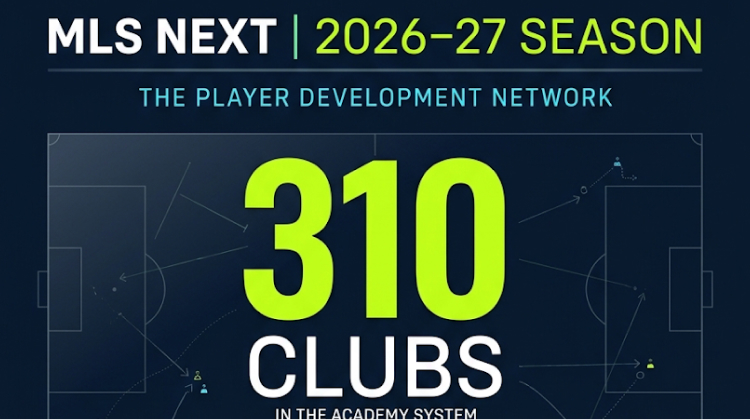
The 2026–27 season features two competition tiers: the MLS NEXT Allstate Homegrown Division and the MLS NEXT Academy Division. Together, they provide different competitive environments for participating clubs and help expand access to organized, high-level youth soccer.
The distinction matters because player development is not a single, identical process for every athlete. Players progress at different rates, and the right environment should challenge them while supporting their technical, tactical, physical and mental growth.
Official season figures published by MLS NEXT demonstrate the scale of the competition:
- 310 clubs participating in the 2026–27 season.
- 2,743 teams competing across the platform.
- More than 53,000 players involved.
- Over 27,000 matches scheduled across the United States and Canada.
- All 30 MLS academies represented within the competition.
These figures illustrate the size of the platform, but they should not be interpreted as a guarantee of professional opportunities. Players still need to demonstrate their abilities, adapt to increasingly demanding competition and continue improving over time.
More Clubs Mean More Competition and Development Opportunities
The expansion of MLS NEXT is particularly relevant for players seeking competitive environments that challenge them beyond ordinary weekend matches.
As the platform brings together professional academies and independent clubs, players can encounter different playing styles, tactical systems and levels of opposition. Regular exposure to demanding matches can help athletes recognize where they excel and which areas require additional work.
For example, a technically gifted midfielder may need to improve decision-making under pressure. A defender might need to become more effective when building attacks from the back, while a forward could benefit from developing better movement away from the ball.
These improvements require more than match experience alone. They depend on structured training, constructive coaching feedback, individual practice and the ability to apply lessons during competition.
The number of clubs participating in MLS NEXT also highlights an important reality: ambitious players should evaluate the quality of their development environment rather than focusing exclusively on a team’s name or reputation.
A strong program should provide age-appropriate coaching, meaningful playing opportunities, clear development goals and a culture that values learning alongside results.
California Players Have a Role in the Growing Youth Soccer Landscape
California remains an important region for American soccer development because of its large youth participation base, established clubs and proximity to several professional organizations.
Southern California, the Bay Area and Northern California all offer competitive soccer environments, although opportunities differ by location, age group and club.
The 2026–27 MLS NEXT expansion announcement identified California-connected organizations among the clubs joining the MLS NEXT Academy Division. These included California Athletic Soccer Club, North Bay Glens FC, Roseville Soccer Club and Strikers FC Orange County.
Their inclusion illustrates how the broader development network extends beyond the academies directly operated by MLS teams. Independent organizations can also participate in structured competition and provide players with opportunities to test themselves against strong opposition.
For families in California, the practical question is whether a particular club offers the right environment for their child’s current ability, long-term development and personal circumstances.
Parents should examine coaching qualifications, training schedules, travel commitments, team placement procedures and the club’s approach to player progression. They should also ask how coaches measure improvement and communicate individual development goals.
Participation in an elite competition can be valuable, but it does not automatically mean every player will receive equal playing time, be recruited by a college or earn a professional contract. Families should seek transparent information about what each program actually provides.

The MLS NEXT Alumni Numbers Show the Potential of the Pathway
One of the strongest arguments for taking youth player development seriously is the progress made by athletes who have moved from academy competition into college and professional soccer.
In its September 3, 2026, season announcement, MLS NEXT reported that 162 MLS NEXT alumni were on MLS rosters for the 2026 season. The organization also reported that 1,661 players who competed in MLS NEXT during the previous season would play college soccer in 2026.
These figures demonstrate that the platform has connections to both collegiate and professional opportunities.
MLS NEXT also reported that 30 Homegrown Players had already made their MLS debuts. The Homegrown Player Rule allows eligible clubs to sign qualifying players developed within their systems, subject to the league’s applicable requirements.
Since the rule was introduced in 2008, 483 Homegrown Players had appeared in at least one regular-season MLS match, according to the same announcement.
These outcomes help illustrate what a sustained development pathway can look like. However, the statistics describe different groups of players and should not be combined to calculate an individual’s chances of reaching the professional level.
For young athletes, the central lesson is to concentrate on controllable factors: training consistently, learning from coaches, maintaining physical readiness, developing game intelligence and performing reliably in competitive situations.
A player’s progress should also be assessed over time. Physical maturity, confidence, tactical understanding and technical execution do not develop at exactly the same rate, especially during adolescence.
MLS NEXT Fest Will Offer Another Major Scouting Opportunity
One of the most significant upcoming events on the 2026–27 calendar is MLS NEXT Fest, scheduled for December 2–13, 2026, at Arizona Athletic Grounds and Red Mountain Park in Mesa, Arizona.
According to MLS NEXT, the event is expected to feature more than 1,600 teams from at least 300 clubs across the U13, U14, U15, U16, U17 and U19 age groups.
The announcement also projects more than 32,000 players competing in approximately 2,400 matches, with hundreds of professional, national team and college scouts expected to attend.
For participating athletes, a showcase event can provide an opportunity to demonstrate their abilities against unfamiliar opponents. Scouts and coaches may evaluate technical quality, movement, decision-making, tactical discipline, athletic attributes and performance under pressure.
Still, players should not approach a showcase as though one tournament will determine their future. Consistency across a season, development within their club and the ability to respond to coaching feedback remain important.
Players preparing for MLS NEXT Fest should focus on their normal development routines, arrive physically prepared, understand their responsibilities within the team and avoid trying to impress observers through unnecessary individual play.
Coaches and parents can support athletes by setting realistic goals, reinforcing positive habits and keeping the emphasis on performance rather than speculation about recruitment.
What Young Players Should Do to Prepare for Elite Competition
As MLS NEXT continues to develop, players who want to compete at a high level can take practical steps to strengthen their readiness.
1. Build a Reliable Technical Foundation
First touch, passing accuracy, ball control, dribbling and finishing remain essential skills. Players should practice these techniques under different levels of pressure and with both feet whenever appropriate.
2. Improve Tactical Awareness
Understanding space, recognizing passing options, anticipating transitions and communicating with teammates can separate effective players from those who rely primarily on athletic ability.
Players should learn not only what decision to make but also why it is appropriate in a particular game situation.
3. Develop Physical Readiness Safely
Speed, coordination, balance, mobility and endurance contribute to performance. Training should be age-appropriate and supervised by qualified professionals, with adequate recovery and attention to injury prevention.
4. Respond Positively to Coaching
Elite development requires athletes to accept constructive criticism, make adjustments and maintain concentration when mistakes occur. A willingness to learn is important throughout the development process.
5. Evaluate Clubs Carefully
Families considering an MLS NEXT environment should ask about team placement, coaching support, playing opportunities, travel expenses and the expected commitment. The best choice is one that supports both the player’s development and the family’s practical needs.
A Bigger Platform Does Not Replace Individual Development
The growth of MLS NEXT reflects the increasing scale and organization of elite youth soccer in North America. With 310 clubs and more than 53,000 players in the 2026–27 season, young athletes have access to a broad network of competition and development opportunities.
Yet the most important part of any pathway remains the individual player. Club participation alone does not determine future success. Technical ability, tactical understanding, effort, resilience, coaching quality and access to appropriate opportunities all influence development.
For California families, the expansion is a reason to learn more about available programs, understand the demands of elite competition and make informed decisions about a player’s next steps.
The goal should not simply be to enter the biggest competition possible. It should be to find an environment where a young athlete can improve, enjoy the game, build confidence and progress at a sustainable pace.
As the 2026–27 season unfolds, MLS NEXT will provide another important setting in which emerging players can test their abilities and pursue their ambitions. For those willing to learn and work consistently, the expanded platform offers opportunities worth following—while the next stage of every player’s journey will ultimately depend on individual development and performance.