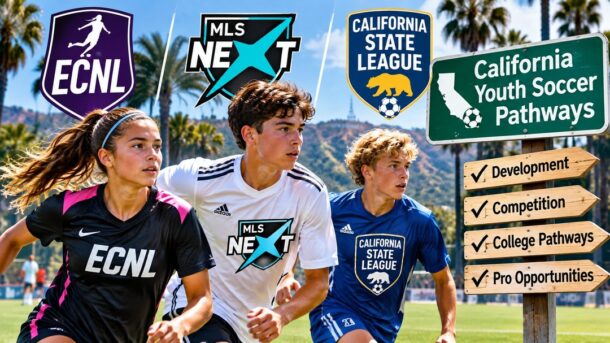
Youth soccer across California represents one of the most competitive, densely populated, and talent-rich athletic ecosystems in the global game. From the historic community complexes of the San Fernando Valley and Orange County to the multi-field tournament facilities across Sacramento, the Bay Area, and the Central Valley, the state serves as an unrivaled development incubator for national team pools, collegiate recruiting classes, and professional domestic leagues. However, for aspiring players and their families, navigating this landscape has evolved into an increasingly complex endeavor. The modern youth game is no longer governed by a single, linear progression model; instead, it comprises a multifaceted network of competing national platforms, regional sanctioning bodies, and community-based leagues.
Making informed decisions requires families and club leaders to understand how competitive standards, travel requirements, financial investments, and college exposure differ across platforms. Whether comparing premier developmental leagues or exploring grassroots competition covered in our Local Leagues coverage, establishing an objective developmental framework ensures that a player’s environment aligns with their technical readiness, academic priorities, and long-term athletic ambitions.
The Architectural Divide: National Platforms Versus Regional State Circuits
The American youth soccer landscape is structurally divided into distinct competitive tiers. In California, this division is shaped by the coexistence of elite national leagues and historic state associations operating under the broader umbrella of the U.S. Soccer Federation.
At the top of the national club pyramid sit two primary club-based platforms: Major League Soccer’s MLS NEXT platform (which serves as the primary boys’ professional academy pipeline) and the Elite Clubs National League (ECNL), which operates top-tier divisions for both boys and girls. These leagues operate on a club-membership model rather than open promotion-and-relegation systems. Member clubs are evaluated on coaching credentials, facility infrastructure, historical player placement, and organizational stability. Competition within these platforms requires significant interstate travel, participation in national showcases across Texas, Florida, and Arizona, and strict compliance with training-to-game volume ratios.
Parallel to these national platforms are the regional leagues administered by California’s two state associations: Cal North (California Youth Soccer Association – North) and Cal South (California State Soccer Association – South), alongside independent regional platforms such as the National Premier Leagues (NPL) administered by US Club Soccer. These regional leagues form the vital bedrock of California soccer, offering tiered competitive divisions ranging from local recreational play to State Premier brackets. For the vast majority of competitive athletes, state association leagues deliver high-level technical development, local rivalry intensity, and prestigious championship tournaments—including the historic State Cup and National Cup competitions—without requiring demanding national travel itineraries.
| Platform Category | Governance & Sanctioning | Geographic Scope & Travel Demands | Scouting & Collegiate Exposure | Primary Family Considerations |
| MLS NEXT | U.S. Soccer Federation & MLS | National & Regional (Multi-state flights & regional showcases) | Direct pipeline to MLS academies, professional scouting, top NCAA Division I programs | Year-round commitment, high financial and travel demands, restricted high school play |
| ECNL (Boys & Girls) | US Club Soccer | Regional conferences with mandatory national showcase travel | Premier college recruiting showcase platform for NCAA DI, DII, and DIII | Substantial travel costs, high competitive pressure, balanced high school allowances |
| US Club Soccer NPL | US Club Soccer | Regional state circuits (intra-state travel with regional playoffs) | Regional collegiate scouting, national championship qualification | Moderate travel costs, competitive league matches, accessible club pathways |
| Cal North / Cal South Premier | US Youth Soccer / State Associations | District and statewide league flights with localized travel | State Cup scouting, regional college showcases, ODP identification | Community-rooted schedules, school-year balance, accessible seasonal registration |
Balancing Roster Depth, Workload Management, and Player Health
The physical demands placed on modern youth soccer players in California have expanded significantly. With many elite teams competing in ten-month operational calendars that incorporate fall league play, winter showcases, spring cup competitions, and summer tournaments, chronic overuse injuries have become a paramount concern for pediatric sports medicine specialists.
Developmentally sound clubs prioritize player workload monitoring to prevent physical burnout and growth-plate injuries. While high-volume competition is frequently marketed as a prerequisite for advancement, physical conditioning research confirms that young athletes require balanced practice-to-game ratios. A training environment providing three structured field sessions for every competitive match allows coaches to teach tactical concepts, spatial positioning, and refined technical fundamentals under controlled physical stress. Conversely, schedules that subject youth players to four or five high-intensity tournament matches over a forty-eight-hour weekend induce acute neuromuscular fatigue, severely degrading movement mechanics and elevating the risk of non-contact ligament tears.
Club leadership and coaching staff must also maintain open communication regarding multi-sport participation and high school soccer involvement. While MLS NEXT rules generally mandate exclusivity that precludes players from representing their scholastic teams, platforms like ECNL and regional state leagues frequently accommodate high school soccer seasons during the winter months. For families following professional soccer alongside youth development, resources such as an EveryGame betting-site rating may provide information about adult-oriented sports wagering platforms, although these services are entirely separate from youth athletics and player development. For many student-athletes, competing for their school community provides irreplaceable leadership opportunities, peer camaraderie, and mental respite from the year-round pressures of the club recruiting circuit.
Deciphering Club Budgets and Hidden Financial Commitments
The financial investment required to sustain a young athlete in California competitive soccer has risen sharply over the past decade. Baseline club registration fees—which fund coaching salaries, field permits, state association registration, and referee fees—typically represent only the baseline threshold of total annual expenditures.
When auditing the real out-of-pocket costs of competitive club soccer, families must account for four major financial categories:
- Club Registration Dues: Annual club tuition typically ranges from $1,500 to $4,500 depending on the level of coaching licensure, facility rental costs, and league tier.
- Mandatory Team Kits: Branded apparel packages, including home, away, and alternate match jerseys, training shirts, warm-up suits, and team bags, often add $300 to $600 per player on multi-year uniform cycles.
- Tournament and Showcase Travel: Flights, vehicle rentals, gas, and family lodging for out-of-region showcase events in cities like Phoenix, Dallas, or Seattle frequently add $2,000 to $6,000+ per season to household budgets.
- Ancillary Assessments: Coaching travel reimbursements, tournament registration surcharges, winter futsal league fees, and team bond assessments billed throughout the calendar year.
Transparent clubs furnish itemized seasonal financial projections before holding competitive tryouts. Furthermore, forward-thinking organizations maintain robust financial aid programs, community sponsorships, and scholarship funds to ensure that financial hardship does not exclude talented players from accessing competitive training environments.
The Role of College Recruitment and Scouting Realities
For high school-aged players, the selection of a competitive club platform often intersects with collegiate recruiting aspirations. While national marketing often suggests that only players in tier-one national platforms earn collegiate opportunities, the empirical reality of college recruiting is far more diverse.
College soccer coaches recruit across every competitive tier in California, from ECNL showcases and MLS NEXT events to Cal South State Cup matches and regional NPL tournaments. Division I, Division II, Division III, NAIA, and California Community College Athletic Association (CCCAA) programs recruit based on specific roster needs, positional profiles, athletic ceiling, and academic credentials. Prospective student-athletes must take proactive ownership of their recruitment process by building academic profiles, assembling verified match footage, researching university academic offerings, and communicating directly with collegiate coaching staffs rather than assuming that league branding alone will secure an athletic roster spot.
Fostering a Lifelong Love for the Beautiful Game
Ultimately, the goal of any youth soccer program should extend beyond scorelines, showcase trophies, or collegiate commitments. The true measure of a club’s culture is its ability to build resilient character, teamwork, sportsmanship, and an enduring passion for soccer that sustains players into adulthood. By evaluating clubs based on coaching methodology, transparent governance, player-centered safety, and realistic financial requirements, California families can navigate the competitive pathway with confidence, ensuring that their athlete’s soccer journey remains a rewarding, healthy, and empowering experience.