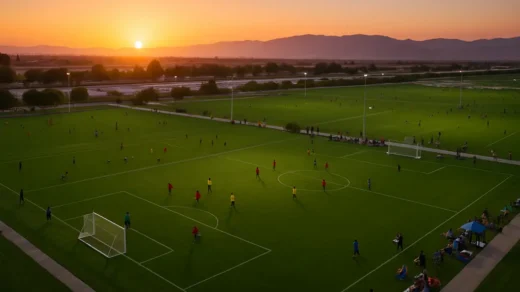
All-Weather Soccer Fields are gaining real attention in Sonoma County because families, coaches, and youth players need dependable places to train and compete across wet months. On March 18, 2025, the Sonoma County Board of Supervisors approved a lease agreement with Atlético Santa Rosa, a nonprofit soccer academy, to design, build, operate, and maintain a new field at Tom Schopflin Fields Regional Park at 4351 Old Redwood Highway in Santa Rosa county lease approval. For local youth soccer, that decision was not just about one facility. It addressed a steady community need: more playable hours, clearer schedules, and field access that can support both player development and family planning.
Why All-Weather Soccer Fields Matter Locally
Sonoma County soccer families know that field access is never just a facility issue. It affects whether a child can keep a consistent training routine, whether a coach can build a season plan, and whether parents can manage transportation around school, work, and siblings. Natural grass fields can be a wonderful surface when weather and maintenance align, but wet-season closures can disrupt practices, matches, and tournament preparation.
The county’s own budget materials described the pressure at Maxwell Farms, noting that existing natural grass fields were often unusable during the wet season, which overlaps with baseball season. Those same materials described the surrounding area as one of the county’s densest unincorporated areas, with more than 60 percent of residents Latino or from other communities of color and poverty levels more than twice the county average county budget request. That context matters because reliable play space can reduce last-minute cancellations and help more families stay connected to local sports programs.
How All-Weather Soccer Fields Support Player Development
For a young player, consistency matters. Repeated touches, team shape work, small-sided games, and goalkeeper sessions all depend on field availability. When practices are canceled often, coaches lose time to teach decision-making and team habits. Players also lose social time with teammates, which is one of the reasons many kids stay in sports through middle school and high school.
All-Weather Soccer Fields can help local clubs and recreational programs keep a steadier rhythm. That does not mean every field should be artificial or that every community has the same needs. It means public agencies, leagues, and families can look at playability as part of a broader youth sports plan. A dependable surface may support younger teams learning basic skills, older teams preparing for league play, and multi-use scheduling that includes other field sports where appropriate.
What Parents And Coaches Can Watch
Parents often experience field shortages in very practical ways: late schedule changes, longer drives, crowded practice windows, or make-up matches that stack up near school events. Coaches feel the pressure too, especially when they must balance limited field time across age groups and ability levels. The Tom Schopflin Fields project gives families a specific public process to follow instead of a vague promise.
The approved lease called for Atlético Santa Rosa to pursue total project funds of $2,400,000. The funding plan included $506,658 in matching funds from Atlético Santa Rosa and a $993,342 grant awarded by Ag + Open Space in the 2024 Community Spaces cycle, according to the county staff materials tied to the March 18, 2025 approval. Construction was required to begin within 24 months of lease execution and be completed within 48 months, with a possible six-month extension for justified delays. As of October 5, 2026, that placed the key construction deadline around March 2027 and the completion deadline around March 2029, depending on the lease execution date and any approved delay.
Tom Schopflin Fields Project Details
The Tom Schopflin Fields Regional Park site is already tied to soccer in Santa Rosa. Research materials described the 21-acre park as having one multi-use soccer/baseball field, two all-weather soccer fields known as Trione Fields, restrooms, a concession building, parking, walking trails, restored wetland, and 4.5 acres of undeveloped land planned for Phase 2. The new field would build on a location where families already gather for training and match days.
The project structure is also notable. The county approved a lease model in which Atlético Santa Rosa would design, build, operate, and maintain the new field. The lease was described as 25 years with a 10-year renewal option. Sonoma County would not charge Atlético Santa Rosa a lease rental fee, and proceeds from field use would support operations, maintenance, and eventual turf replacement. For community members, the key question will be whether that operating model keeps access broad enough for local youth teams while still covering the real costs of care.
Public Use And Scheduled Access
The public access requirement is one of the most relevant details for families. The new field was set to be open for scheduled use by nonprofit and for-profit athletic groups for at least 500 hours per year. That minimum can give local organizations a clearer baseline when they plan seasons, clinics, and shared field calendars.
Good scheduling will still require communication. A field can be built well and still create frustration if families do not know how hours are allocated, which groups have priority, or how conflicts are resolved. Local soccer leaders should ask for clear booking processes, public-facing calendars where possible, and routine check-ins among clubs, schools, county staff, and community groups. For teams seeking other ways to support facility planning, local organizers may also find value in reviewing how youth soccer grants can help communities prepare stronger field projects.
Surface Materials And Maintenance Planning
The planned field materials were identified in project materials as FieldTurf 2-inch Vertex Prime synthetic turf with PureFill cork infill. The cork infill was described as non-toxic, 100 percent organic, and fully recyclable at the end of its useful life. The useful life of the field was estimated at 10 years. Those details matter because surface choice affects maintenance planning, heat concerns, long-term replacement costs, and community trust.
Families should be able to ask plain questions about surface care: how the field will be inspected, how infill will be managed, how heavy-use periods will be handled, and how replacement money will be set aside. A field that is playable year-round still needs disciplined maintenance. Coaches can help by teaching players to respect facility rules, use proper footwear, and leave the space ready for the next group.
Community Benefits Beyond Match Days

All-Weather Soccer Fields can support more than practices and weekend games. They can help local businesses that serve families on busy sports days, from restaurants to sporting goods shops. They can give nonprofit programs more confidence when organizing clinics, camps, and community events. They can also reduce pressure on overused fields elsewhere in the county if scheduling is coordinated fairly.
For a community advocate like me, the strongest projects are the ones that connect public benefit with daily family needs. A child does not think in policy terms when a field is closed. They know they missed practice, lost time with friends, or had a game moved far from home. Families feel those changes in gas costs, meals, homework schedules, and work shifts. Better local facilities can soften those burdens.
There is also a sports identity piece. Sonoma County has many families who care deeply about soccer, from first-time recreational players to academy-level athletes. When public facilities improve, that sends a message that youth sports belong in the community conversation. The goal should not be access for only the most organized or best-funded programs. The goal should be a shared field network that welcomes beginners, supports committed players, and respects the coaches and volunteers who keep teams running.
Equity In Field Access
The Maxwell Farms budget materials are a reminder that facility planning is also about fairness. If wetter months make fields unusable in high-need areas, then the children with the fewest backup options often lose the most playing time. That is why public access requirements, transparent scheduling, and multilingual family communication should be treated as core parts of any field project.
All-Weather Soccer Fields are not a cure for every barrier in youth sports. Registration fees, transportation, equipment costs, coaching education, and family work schedules still shape participation. But reliable fields can remove one major obstacle. When paired with scholarships, shared-use agreements, and strong volunteer networks, they can help keep more children active and connected.
What All-Weather Soccer Fields Mean For Sonoma Youth
The Tom Schopflin Fields Phase 2 approval gave Sonoma County soccer families a concrete project to follow, with public records, funding goals, access expectations, and lease terms attached. The key dates are clear enough for community oversight: approval occurred on March 18, 2025; construction was required to start within 24 months of lease execution; completion was required within 48 months, with a possible six-month extension for justified delays.
For parents, the next useful step is to stay informed through official county updates and local league communication. For coaches, it is a chance to think about how added field capacity could support balanced training loads and better age-group planning. For local businesses and civic partners, it is an opening to support youth sports in ways that reach families across neighborhoods.
If the project meets its public access goals and is maintained with care, All-Weather Soccer Fields at Tom Schopflin Fields can help Sonoma County move toward steadier play, stronger youth development, and more dependable community sports spaces.